The Hidden Cost of Disconnected Business Systems
A practical look at how disconnected software quietly creates extra work, unreliable data, missed opportunities, and unnecessary costs as a business grows.
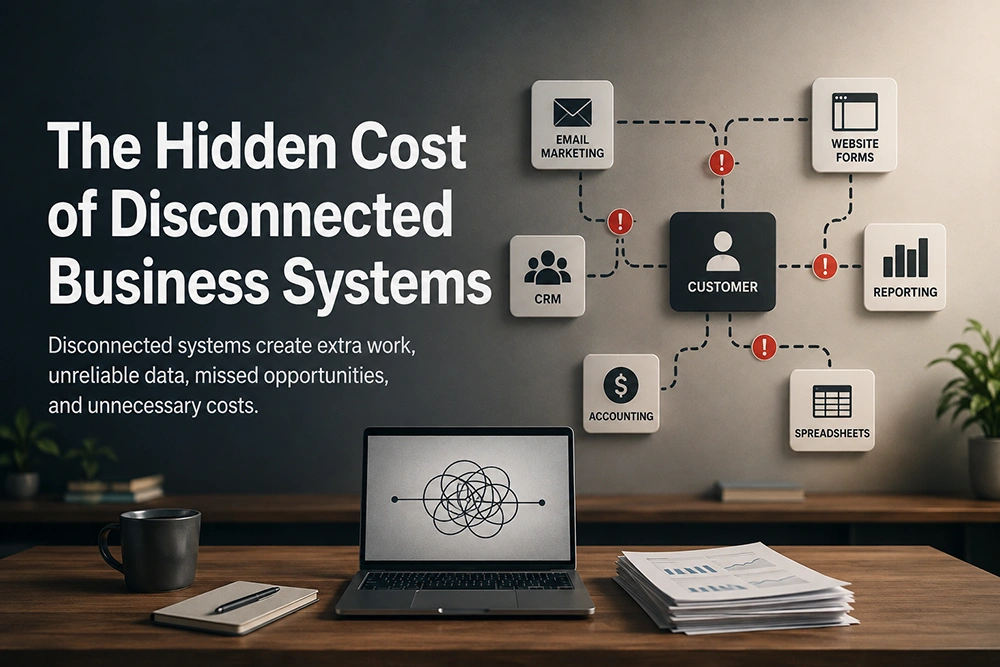
A growing business came to us with what initially sounded like several unrelated problems.
Website leads sometimes took too long to reach sales. Marketing had trouble knowing which campaigns actually generated customers. Employees spent hours updating spreadsheets. Customer information existed in several different systems, and reports required someone to manually bring everything together.
None of the company's software was necessarily broken.
The CRM worked. The website worked. The email marketing platform worked. The reporting tools worked.
The real problem was that they all worked independently.
The company didn't need another piece of software. It needed the software it already had to start working together.
This is a problem we see frequently as businesses grow.
New technology gets added whenever a new need appears. A CRM gets introduced for sales. An email platform handles marketing. Website forms collect inquiries. Operations builds spreadsheets. Accounting uses another application. Management adds reporting tools.
Each decision makes sense on its own.
But eventually employees become responsible for moving information between all of those systems.
The Problem Wasn't the Software. It Was Everything Happening Between It.
The easiest way to understand the problem was to stop looking at individual applications and start following information through the business.
What happened when someone filled out a website form?
Where did that information go next?
How did marketing know whether that person eventually became a customer?
How did management connect advertising spend to actual revenue?
Once we started asking those questions, the gaps became obvious.
CRM + Email
The CRM didn't reliably communicate customer changes to the email marketing platform.
Website + CRM
Website leads weren't automatically entering the system sales used every day.
Systems + Employees
Employees were repeatedly copying information from one application into another.
Data + Reporting
Reports required exporting information and rebuilding it inside spreadsheets.
Sales + Marketing
Both teams had valuable information, but they weren't working from the same view of the customer.
The CRM Didn't Talk to the Email Platform
Sales relied on the CRM to manage prospects and customers. Marketing relied on a separate platform for campaigns and automated emails.
Both systems contained many of the same contacts, but the information wasn't consistently synchronized.
When a prospect became a customer, that status could change inside the CRM without changing in the marketing platform. New contacts were sometimes manually exported and imported. Sales activity wasn't available to marketing, while marketing engagement wasn't always visible to sales.
Over time, the company had effectively created several versions of its customer database.
What was this actually costing the business?
- Employees spent time exporting and importing customer lists.
- Marketing sometimes worked with outdated customer information.
- Sales couldn't easily see marketing engagement.
- Marketing couldn't easily connect campaigns to sales results.
- Customers could receive messages that no longer matched their relationship with the company.
Through system integrations and marketing automation , the CRM and email platform can become parts of the same customer lifecycle instead of two separate databases that employees have to maintain.
Website Leads Weren't Entering the CRM
The company's website was generating inquiries.
But submitting a form didn't automatically create a lead inside the CRM.
Instead, the form sent an email. Someone had to see that email, open the CRM, create the contact, copy over the information, assign the lead, and begin the follow-up process.
When business was quiet, this worked reasonably well.
When things got busy, leads could sit in an inbox.
If a customer already entered the information once, why was an employee entering it again?
Connecting the website directly to the CRM changes that process completely.
A form submission can automatically create or update a contact, identify the lead source, assign responsibility, create a task, trigger a notification, and begin an appropriate follow-up sequence.
One integration removes several manual steps while improving speed, consistency, and visibility.
Employees Had Become the Integration Between Systems
The biggest warning sign wasn't found inside any piece of software.
It was found by watching how employees actually worked.
Customer records were copied into spreadsheets. Information was transferred between applications. Reports were rebuilt manually. New customers required employees to repeat the same setup steps across several platforms.
None of those tasks seemed especially difficult.
That's exactly why they had remained part of the process for so long.
Ten minutes here and fifteen minutes there don't look like major operational problems. Multiply those tasks across several employees, hundreds of customers, and an entire year and the cost becomes much easier to see.
Hours lost to repetitive work.
More manual entry means more opportunities for mistakes.
More customers create more administrative work.
This is where automation becomes valuable.
APIs, workflow automation, scheduled processes, and targeted software development can handle many of the repetitive tasks employees are performing manually.
The objective isn't to replace employees.
It's to stop paying skilled employees to act as the connection between software systems.
Your Employees Shouldn't Have to Connect Your Software Manually
Skale can help identify disconnected systems, repetitive processes, and opportunities to automate the work happening between your existing tools.
Reporting Required Spreadsheets
Management wasn't asking complicated questions.
How many leads did marketing generate? Which campaigns produced customers? How long did opportunities take to close? Which services generated the most revenue? Where were prospects dropping out?
The answers existed.
The problem was that pieces of the answer existed in different places.
Someone had to export information from the CRM, website analytics, advertising platforms, email software, and other systems before combining everything in spreadsheets.
Employees were spending their time building reports instead of analyzing them.
Better dashboards don't fix bad data flow.
Reporting becomes dramatically easier when the systems creating the data are connected first.
Once data moves consistently between platforms, reporting can become centralized and automated.
Instead of asking someone to assemble the story every week or month, leadership can spend that time understanding what the story actually means.
Sales and Marketing Were Working From Different Data
Marketing measured clicks, website activity, form submissions, email engagement, and campaign performance.
Sales measured conversations, opportunities, proposals, customers, and revenue.
Both teams had useful information.
Neither team had the complete picture.
Marketing could identify which campaigns generated inquiries but struggled to determine which inquiries became valuable customers.
Sales knew which opportunities closed but often had little visibility into what the prospect did before reaching them.
That made a familiar conversation almost inevitable:
"We're generating leads."
"But they're not turning into customers."
Without shared data, neither side could confidently explain what was happening.
Connecting website activity, marketing engagement, CRM information, sales outcomes, and customer data creates a much more useful view of the customer journey.
The applications don't necessarily need to be replaced or consolidated into one giant platform.
They simply need to exchange the right information at the right time.
The Turning Point: Stop Asking Which Software to Replace
At first, replacing software seemed like the obvious answer.
Maybe the company needed a better CRM. Maybe it needed a different email platform. Maybe a new reporting tool would solve the problem.
But most of the individual applications were already capable of doing their jobs.
How should information move through the business from the moment someone becomes a lead through the entire customer relationship?
That question changed the project.
Instead of evaluating every application independently, we started looking at the business as one connected system.
- Which system should own customer information?
- What should happen automatically when a new lead arrives?
- Which events should trigger follow-up?
- Where are employees manually moving data?
- Where are delays occurring?
- What information do employees need but can't easily access?
- Which repetitive tasks could happen automatically?
Those questions exposed opportunities that buying another piece of software would never have solved.
Connected Systems Become Growth Infrastructure
Technology should make growth easier.
Too often, the opposite happens.
Every new lead creates another manual entry. Every new customer creates more administrative steps. Every marketing channel creates another report. Every employee needs to learn the workarounds holding everything together.
Eventually, growth creates more operational friction instead of more efficiency.
This is why we approach these challenges as Growth Infrastructure .
The objective isn't simply to connect two APIs or automate one task.
It's to create a technical foundation where information moves reliably through the business, routine work happens automatically, and employees have access to the information they need.
Growth should increase opportunity without creating the same increase in administrative work.
Connecting a Business Usually Requires More Than One Solution
The right approach depends on where your information lives, how your employees work, and what needs to happen between your systems.
Automation
Remove repetitive work and allow routine business processes to happen automatically.
Automation Services ?System Integrations
Connect the applications you already use so information can move between them reliably.
System Integrations ?CRM Solutions
Create a more useful central view of prospects, customers, activity, and sales opportunities.
CRM Solutions ?Marketing Automation
Connect marketing activity with customer data and create more relevant follow-up.
Marketing Automation ?Growth Infrastructure
Align technology, processes, data, and operations around the way your business needs to grow.
Growth Infrastructure ?Software Development
Fill the gaps when off-the-shelf platforms don't support the workflow your business requires.
Software Development ?Does This Sound Like Your Business?
Disconnected systems aren't always obvious because nothing necessarily appears broken.
Look instead at the work your employees are doing because your technology can't exchange information on its own.
- Employees regularly copy and paste information between systems.
- Website inquiries have to be manually entered into your CRM.
- Your CRM and email platform contain different customer data.
- Reporting requires several exports and spreadsheets.
- Sales and marketing disagree about where leads or revenue come from.
- Important processes depend on employees remembering what to do next.
- The same customer information exists in several places.
- More customers automatically mean more administrative work.
If several of these sound familiar, the problem may not be the individual applications you're using. It may be the connections between them.
The Most Expensive Problems May Be Hiding Between Your Systems
Businesses notice quickly when software stops working.
Disconnected systems are harder to notice because everything can appear to be working normally.
The CRM opens. The website receives forms. Emails send. Spreadsheets calculate totals.
The cost appears in everything employees have to do between those systems.
It appears when someone spends an hour assembling a report that could have been generated automatically.
When a salesperson manually enters a website lead.
When marketing exports another customer list.
When someone fixes information that was copied incorrectly.
When leadership can't confidently connect marketing activity to revenue.
These small problems become increasingly expensive as your business grows.
You may not need to replace all of your software. You may simply need your technology to start working like one business instead of a collection of separate tools.
Find Out Where Disconnected Systems Are Costing Your Business Time
Skale can review your tools, workflows, data movement, and repetitive processes to identify opportunities for integration and automation.
You don't need to know which software should change. We can start by looking at how your business operates today and where technology is creating unnecessary friction.
Start a Conversation