AI or Human? How Generative AI Is Changing Writing & Trust
AI can write an email, draft an article, and polish a message in seconds. But when everyone has access to the same technology, what happens to originality, authenticity, and trust?
Artificial Intelligence & Communication
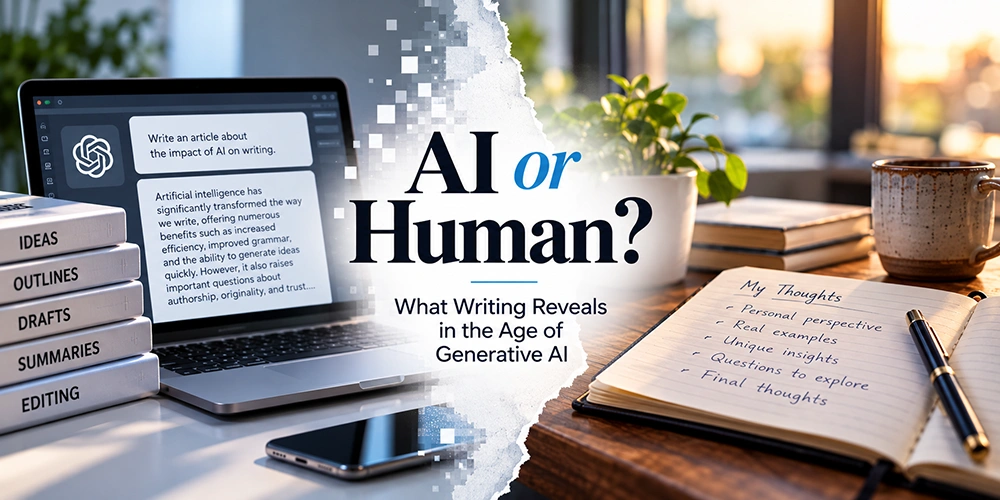
AI or Human? What Writing Reveals in the Age of Generative AI
AI can write an email, draft an article, and polish a message in seconds. But when everyone has access to the same technology, what happens to originality, authenticity, and trust?
Generative AI has moved quickly from novelty to everyday writing assistant, helping people brainstorm, draft, edit, and summarize. Its growing role also raises questions about authorship, accuracy, creativity, and trust.
Understanding what AI writing does well—and where it falls short—can help readers and writers make more thoughtful choices.
The Detection Question
Can You Really Tell the Difference Between AI and Human Writing?
Sometimes readers can spot AI-generated prose, but there is no universal giveaway.
A 2025 study published by the Association for Computational Linguistics found that frequent users of large language models were unusually accurate: a majority vote among five experienced annotators misclassified only one of 300 nonfiction articles.
Experience Makes a Difference
The result shows that highly experienced readers can sometimes distinguish AI writing remarkably well. It does not mean everyone can reliably identify AI-generated content.
Even so, a 2026 review of 40 studies found that clues such as polished formality, predictable structure, and repetition vary by genre and can disappear after human editing.
Common Clues Readers Look For
Overly Polished Language
Consistently formal wording that can feel disconnected from a writer's personality.
Predictable Structure
Repeated patterns of introductions, balanced arguments, and tidy conclusions.
Repetitive Phrasing
Similar ideas restated in slightly different ways without adding much meaning.
Limited Personal Detail
Generic examples or explanations without distinctive experiences or observations.
The Adoption Shift
How Much Writing Are People Actually Doing with AI?
Reliable numbers depend on the population and the type of writing being measured, but recent student surveys show that AI-assisted writing is already widespread.
UK undergraduates surveyed who used some form of AI
UK undergraduates who used generative AI for assessments
UCLA graduates surveyed who used generative AI for coursework
The Higher Education Policy Institute's 2025 survey of 1,041 UK undergraduates found that text generation was the most common use of generative AI for assessments.
At UCLA, 57% of surveyed 2025 graduates used generative AI to brainstorm a writing project or presentation, while 31% used it to draft written assignments.
The Trade-Off
AI Makes Writing Easier. Does It Always Make It Better?
Like most technology, generative AI is neither inherently good nor bad for writing. Its impact depends on how it is used and how much responsibility the writer retains.
The Benefits
Where AI Helps Writers
- Brainstorming ideas and exploring new angles
- Creating outlines and organizing thoughts
- Overcoming the difficulty of getting started
- Summarizing notes and lengthy information
- Improving grammar and sentence clarity
- Adapting a draft for different audiences
- Reducing time spent on routine editing
Used as a collaborator, AI can leave more time for verifying facts, refining ideas, and developing a distinctive voice.
The Risks
Where AI Falls Short
- Producing inaccurate or invented claims
- Generating nonexistent references or sources
- Introducing biased or misleading framing
- Making different writers sound alike
- Reducing independent writing practice
- Creating privacy and copyright concerns
- Blurring authorship and academic integrity
Fluent writing can still be wrong. A polished paragraph should never be mistaken for a verified or trustworthy one.
In the 2025 HEPI survey, students most often pointed to saving time and improving work quality as reasons for using AI. Those benefits are meaningful, but they do not eliminate the need for independent thinking.
The Trust Factor
Does It Matter Whether a Human or AI Wrote It?
For many readers, the answer depends on the purpose of the writing and how much human oversight remains.
Transparency Shapes Trust
In 2025 research involving news audiences, more than 60% supported AI only when news organizations established clear ethical guidelines, while 30% opposed its use in news altogether.
Other controlled research has found that disclosure can lower perceptions of trustworthiness and sincerity, particularly in personal or relationship-focused messages.
Context Changes Expectations
Business Communication
Readers may accept AI assistance when the message is accurate, relevant, and reviewed by a responsible person.
Journalism & Research
Source verification, editorial accountability, and transparency carry greater importance.
Personal Messages
Authenticity and sincerity may matter as much as the quality of the prose itself.
A Better Approach
How to Use AI Without Losing Your Own Voice
A responsible workflow begins with treating AI output as a draft or suggestion, not as verified truth. The goal is to make writing more effective without outsourcing the thinking behind it.
Start with Your Own Ideas
Decide what you want to communicate before asking AI to organize or improve the message.
Use AI to Explore Possibilities
Ask for outlines, alternative wording, and suggestions rather than treating its first response as the finished product.
Verify Every Important Claim
Check statistics, quotations, references, and factual statements against reliable sources.
Make the Writing Yours
Rewrite generic passages, add firsthand knowledge, and remove language you would never naturally use.
Protect Sensitive Information
Keep private, confidential, or proprietary material out of unapproved AI tools and prompts.
Be Transparent When Required
Follow school, employer, publisher, and audience expectations about AI assistance and original human authorship.
Before You Publish, Ask Yourself
- Are the facts and sources accurate?
- Does this sound like me or my organization?
- Have I added meaningful original insight?
- Could anything here mislead the reader?
- Have I followed applicable disclosure rules?
- Am I comfortable taking responsibility for it?
Human Judgment Still Matters
The Future of Writing Isn't Simply AI vs. Human
The line between human and AI writing is becoming less visible because much modern writing is collaborative rather than purely one or the other.
AI can make drafting faster and more accessible, but it cannot take responsibility for accuracy, ethics, or the consequences of a message.
The most useful question may not be whether a machine touched the text, but whether a person thoughtfully directed, checked, and owned the final result.
Practical AI. Better Systems. Human Oversight.
AI Should Support the Way You Work, Not Replace the Thinking Behind It.
Whether you're exploring AI-assisted workflows, improving business communication, or trying to connect disconnected systems, Skale can help identify practical opportunities to make your technology work better.
Start a Conversation →